

Pneumatic Door Closer Supplier Delhi: A Complete Guide to Features, Types, and Applications
A door that swings shut on its own is one of those small conveniences nobody notices until it is missing. In homes, offices, schools, clinics and shops, doors that stay open or slam shut cause everyday problems, from wasted effort to damaged frames. Door closers solve this by returning the door to its closed position in a controlled way.
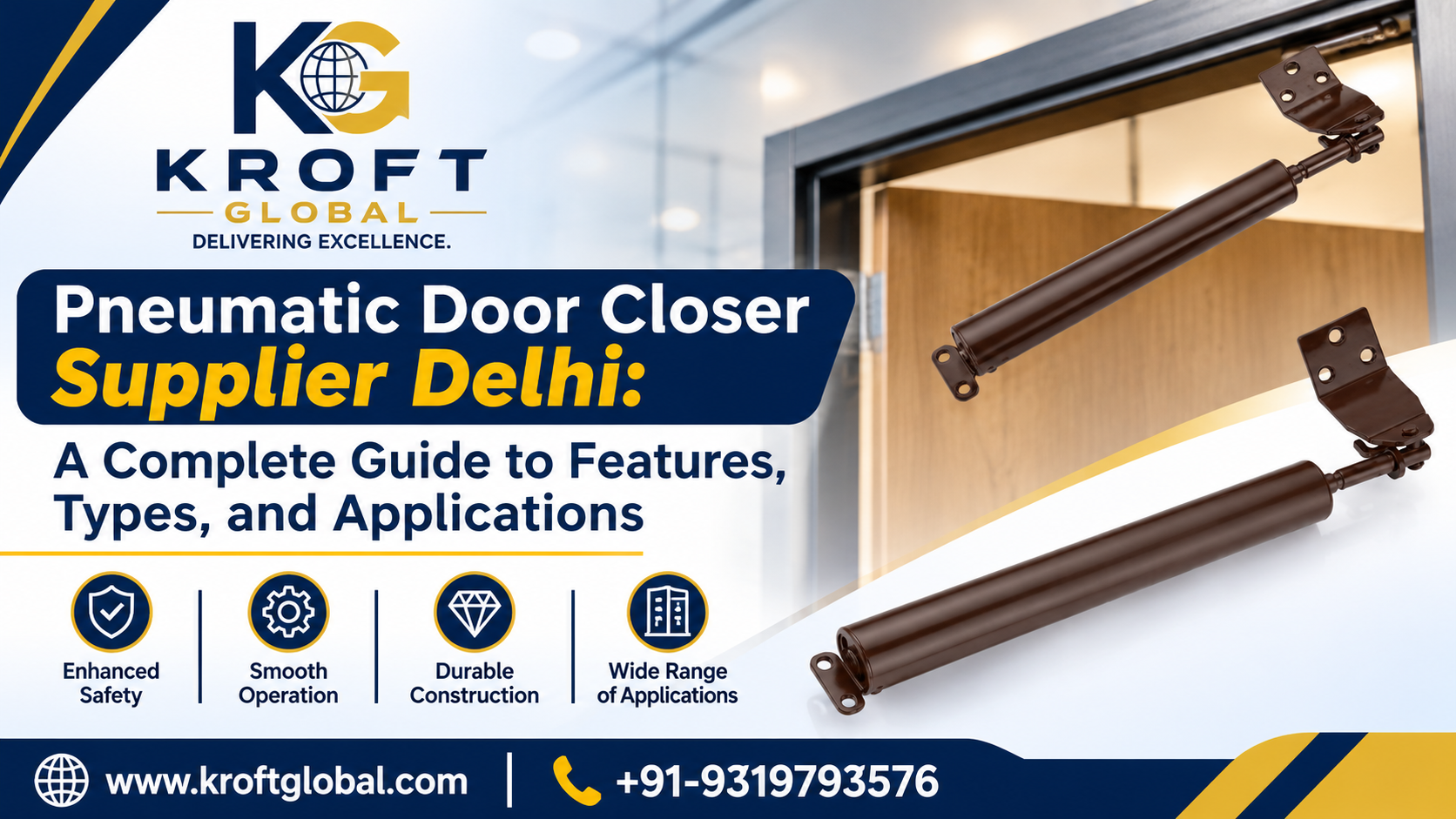
Pneumatic door closers are one option in this category. They use air inside a cylinder to manage how the door moves back to its frame, and they are commonly considered for indoor doors that are used often. If you are searching for a pneumatic door closer supplier in Delhi, it helps to understand how these products work and what separates one option from another before you buy.
This guide covers what a pneumatic door closer is, how it works, its features, how it compares with other door closer types, and where it is typically used. It also introduces Kroft Global, a Delhi-based company that lists a pneumatic door closer on its website.
What Is a Pneumatic Door Closer?
A pneumatic door closer is a device fitted to a door and its frame that closes the door automatically after it has been opened. What makes it pneumatic is the way it controls that movement: it uses air pressure inside a cylinder rather than relying only on a spring.
In simple terms, the closer lets the door return to its closed position at a regulated pace instead of swinging back freely. Its basic purpose is convenience and controlled door movement, particularly for doors that people pass through many times a day.
How Does a Pneumatic Door Closer Work?
The general principle is the same across most pneumatic designs, though details vary by product:
- Opening the door: When the door is pushed or pulled open, the internal mechanism is compressed.
- Storing energy: The compression stores energy, usually in a spring, that wants to return the door to its closed position.
- Controlled air movement: Air moving through the cylinder resists the return, which slows the closing instead of letting the door snap shut.
- Closing: The door moves back toward its frame at a regulated speed.
Some designs allow the closing speed to be adjusted. Whether a particular product includes this, and how, should be confirmed from its specifications rather than assumed.
Key Features of Pneumatic Door Closers
These are general characteristics of pneumatic door closers as a category. They are not confirmed specifications of any single product.
- Controlled closing movement: The air-regulated action helps the door return at a steady pace.
- Automatic closing: The door shuts without anyone pushing it closed.
- Practical, convenient operation: Users simply open and release the door.
- Suitability for different doors: Designs are made for various door types, so matching the closer to the door matters.
- Compact design, where applicable: Many closers are small enough to fit neatly on a door or frame.
- Ease of use and maintenance: Basic upkeep usually means periodic checks of fixing and movement.
For product-specific features, always refer to the supplier’s product page or ask the supplier directly.
Different Types of Door Closers
Door closers are described in two overlapping ways: by how they operate and by how they are mounted.
- Pneumatic door closers use controlled air movement.
- Hydraulic door closers use fluid to regulate closing.
- Overhead door closers are mounted near the top of the door.
- Surface-mounted door closers are installed on the visible surface of the door or frame.
| Door Closer Type | General Working Principle | Common Consideration |
| Pneumatic Door Closer | Uses controlled air movement in its mechanism | Suitable product selection depends on door requirements |
| Hydraulic Door Closer | Uses hydraulic fluid to control closing movement | Often selected where controlled closing is required |
| Overhead Door Closer | Mounted near the top of the door | Installation and door compatibility matter |
| Surface-Mounted Door Closer | Installed on the visible surface of the door or frame | Mounting space and appearance should be considered |
These categories can overlap. Overhead and surface-mounted describe mounting styles, while pneumatic and hydraulic describe operating mechanisms, so one closer can fit more than one label. Product availability for each type should be confirmed with the supplier.
Applications of Pneumatic Door Closers
Pneumatic door closers are commonly considered for indoor doors in places such as:
- Residential buildings: Room, balcony or utility doors that should not be left open.
- Offices and corporate spaces: Cabin, meeting room and pantry doors used throughout the day.
- Schools and educational institutions: Classroom and corridor doors with frequent traffic.
- Hospitals and healthcare facilities: Doors in wards, consulting rooms and passages that are opened often.
- Retail shops and commercial buildings: Store rooms, staff areas and back-of-house doors.
- Other suitable indoor environments: Any interior door that benefits from controlled, automatic closing.
In these settings, automatic closing supports convenience, helps with orderly access and makes everyday door management easier, since people do not need to remember to shut the door behind them.
Benefits of Using a Pneumatic Door Closer
- Automatic closing convenience: Doors return to their closed position without manual effort.
- Controlled door movement: The door does not swing freely, which helps reduce sudden impact.
- Less manual closing: People do not have to remember to close the door behind them.
- Organised indoor spaces: Doors that close properly help keep rooms and passages tidy and defined.
- Practical in busy areas: Doors used often benefit most from consistent, automatic closing.
It is worth keeping expectations realistic. A door closer is a convenience and door-control device. It should not be assumed to provide security, fire safety, noise reduction or energy savings unless the specific product is supported by the relevant certifications and evidence.
How to Choose the Right Pneumatic Door Closer Supplier in Delhi
Picking a pneumatic door closer supplier in Delhi is partly about the product and partly about the supplier. Consider the following:
- Door type, size and weight: A closer must suit the door it will be fitted to. Ask the supplier which doors a product is meant for.
- Compatibility with the application: Indoor, outdoor, light or heavy traffic all affect the choice.
- Material and build quality: Check the finish and construction, and ask what the product is made of instead of assuming.
- Closing mechanism and adjustment: Find out whether closing speed can be adjusted and how.
- Installation requirements: Ask about mounting method and what fittings are needed.
- Maintenance and after-sales support: Know who to contact if a closer needs attention.
- Product information and availability: A supplier who shares clear product details and confirms availability makes planning easier.
If possible, give the supplier your door details and intended use so the recommendation fits your requirement.
Why Consider Kroft Global?
Kroft Global is a company based in Chandni Chowk, New Delhi, that lists a pneumatic door closer on its website. Buyers can view the product information on that page.
Since suitability depends on the door and its use, the practical next step is to share your requirements with the team and confirm details such as specifications, materials and availability directly. You can reach them through the contact page or the details at the end of this article.
Conclusion
Pneumatic door closers bring automatic, controlled closing to doors in homes, offices, schools, healthcare facilities and shops. Knowing how they work, how they differ from other types and what to ask a supplier makes it easier to choose a product that fits the door and its use.
If you are looking for a pneumatic door closer supplier in Delhi, explore the Kroft Global product page or contact the company to discuss your requirements.
Frequently Asked Questions (FAQs)
1. What is a pneumatic door closer?
It is a device that closes a door automatically, using air movement inside its mechanism to control how the door returns to its frame.
2. How does a pneumatic door closer work?
Opening the door compresses the mechanism and stores energy. Controlled air movement then regulates the return, so the door closes at a steady pace.
3. What is the difference between pneumatic and hydraulic door closers?
Pneumatic closers use air to control closing, while hydraulic closers use fluid. Overhead and surface-mounted describe how a closer is mounted, so they can overlap with either type.
4. Where are pneumatic door closers commonly used?
They are used on indoor doors in homes, offices, schools, healthcare facilities and shops, especially doors opened frequently.
5. How can I enquire about a door closer from Kroft Global?
View the product page and contact the team using the details below to confirm specifications and availability.
Contact Kroft Global
Company: Kroft Global
Phone: +91-9319793576
Email: kroftglobal@gmail.com
Address: Building No./Flat No.: 1948, Main Road Lal Kuan, Chandni Chowk Area, New Delhi, 110006
Website: www.kroftglobal.com